Is PET film or Polycarbonate film right for my project?
PET film and polycarbonate film look pretty similar at first glance. They’re both durable plastic films used across various industries, but once you dig into how they’re actually used, the differences and your choice may become much more obvious.
Keep reading to get a better understanding of which material will suit your project best.
What Is PET Film?
PET (polyethylene terephthalate) is one of the most widely used polyester films on the market. It provides a combination of strength, dimensional stability, chemical resistance, and affordability, which makes it so popular. You’ll find PET films everywhere from medical devices to industrial equipment.
Common uses include:
- Membrane switches
- Nameplates and labels
- Flexible printed electronics
- Electrical insulation
- Medical components
- Industrial laminates
- Packaging
- Graphic overlays
Consistency is one of PET’s biggest strengths. It stays dimensionally stable during manufacturing. This makes PET film a great choice for precision parts especially where tight tolerances matter.
What Is Polycarbonate Film?
Polycarbonate film is designed for applications where toughness is the priority.
It’s incredibly impact resistant while still offering excellent optical clarity. It’s also easy to thermoform and emboss. This makes it ideal for parts that need to be shaped or handled frequently.
You’ll often see polycarbonate used for:
- Equipment faceplates
- Control panels
- Display windows
- Machine guards
- Automotive interiors
- Medical devices
- Protective shields
- Graphic overlays
If a part is likely to get bumped, dropped, flexed, or heavily used, polycarbonate is often the better choice.
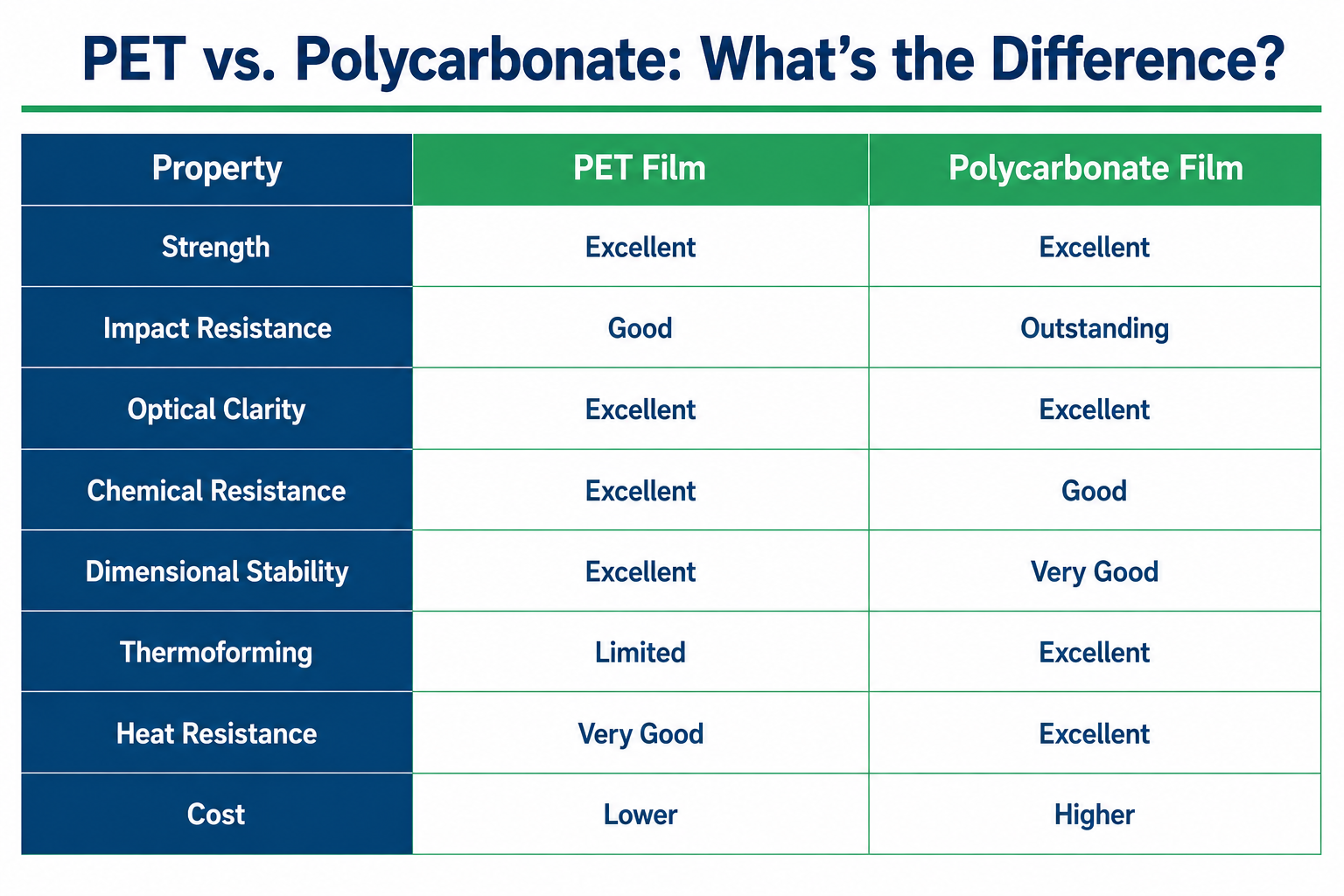
Both materials perform extremely well. The question is which characteristics matter most for your project.
When PET Film Makes More Sense
PET is often the go-to choice when you need reliable performance without increasing material costs.
It’s an excellent option if your application requires:
- Strong chemical resistance
- Tight manufacturing tolerances
- Electrical insulation
- Long-term dimensional stability
- High-quality printing
- A more budget-friendly material
For many industrial and electronic applications, PET checks every box while keeping costs under control.
When You Should Choose Polycarbonate
If your product needs to stand up to physical abuse, polycarbonate usually has the edge.
It’s a great fit when your application involves:
- Frequent impacts
- Repeated flexing
- Thermoformed parts
- Deep embossing
- Higher operating temperatures
- Heavy daily use
That’s why it’s commonly used for control panels, equipment interfaces, protective covers, and products that people interact with every day.
What About Optical Clarity?
Both PET and Polycarbonate films offer excellent clarity, but they’re often used for different reasons.
PET’s smooth and glossy appearance works exceptionally well for printed graphics, labels, and decorative overlays. It is typical to choose a polycarbonate film when you need both transparency and toughness. That’s why polycarbonate is commonly used for equipment windows, display covers, and protective barriers.
Which One Is More Durable?
If by durable you’re talking about resistance to chemicals, moisture, and dimensional changes over time, PET performs exceptionally well.
If you’re talking about surviving impacts, repeated bending, or years of heavy use, polycarbonate is hard to beat.
Neither material is universally better. They’re simply engineered for different jobs.
How Much Does Cost Matter?
Price is always part of the conversation.
PET film is generally more economical while still delivering excellent overall performance. For many manufacturers, that makes it the obvious choice.
Polycarbonate typically costs more, but that added investment can pay off when impact resistance, thermoforming, or long-term durability are critical to the finished product.
Choosing the least expensive material isn’t the most cost-effective decision if it can’t handle the demands of the application.
So, Which Film Is Right for You?
As a general rule:
Choose PET film if you need:
- Excellent chemical resistance
- Tight dimensional stability
- Electrical insulation
- Outstanding printability
- A cost-effective solution
Choose polycarbonate film if you need:
- Superior impact resistance
- Thermoforming capability
- Better high-temperature performance
- Deep embossing
- Maximum durability in demanding environments
The right answer comes down to how the finished part will actually be used.
Need Help Choosing between PET and Polycarbonate Films?
Our plastics experts help manufacturers evaluate which films are best for their projects every day. We can help you explore the benefits of PET or Polycarbonate films, or another specialty film. Together we’ll identify the material that fits both your application and your production process, and you can request a sample before your purchase. Contact our team today to discuss your project.
Recent Posts
Help us spread the word by sharing with the community!