Once you’ve selected the type of film you need, the next important question becomes: How should the film arrive at your facility?
For some applications, the answer is simple. You need film on a roll, cut to the exact width your equipment requires. For others, rolls create more work than they solve. You may need flat sheets that can be stacked, printed, packaged, assembled, or moved directly into production.
That is where plastic film slitting and plastic film sheeting come in. Both are common film converting services. Both help turn larger rolls of film into something more useful. The difference is the final format.
Slitting keeps the film in roll form.
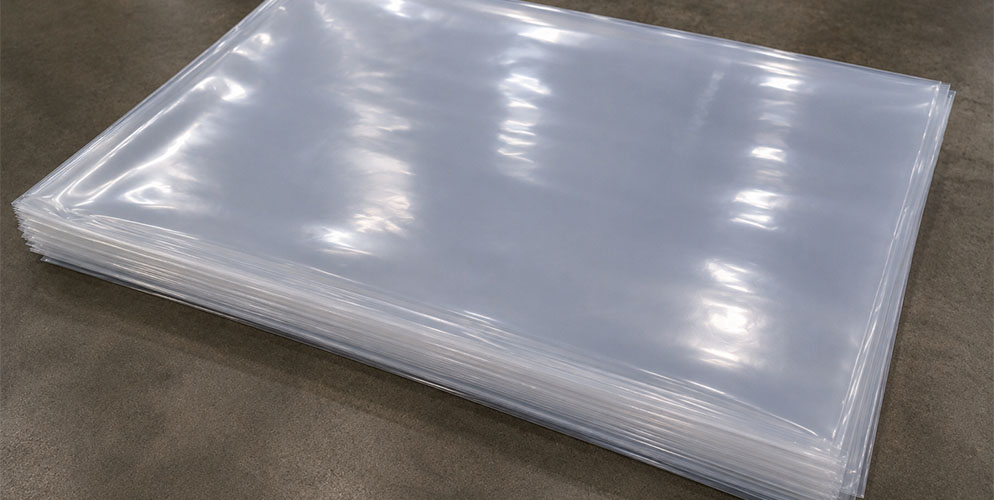
Sheeting turns the film into individual flat pieces.
Simple enough. But choosing the right one depends on how the material will actually be used.
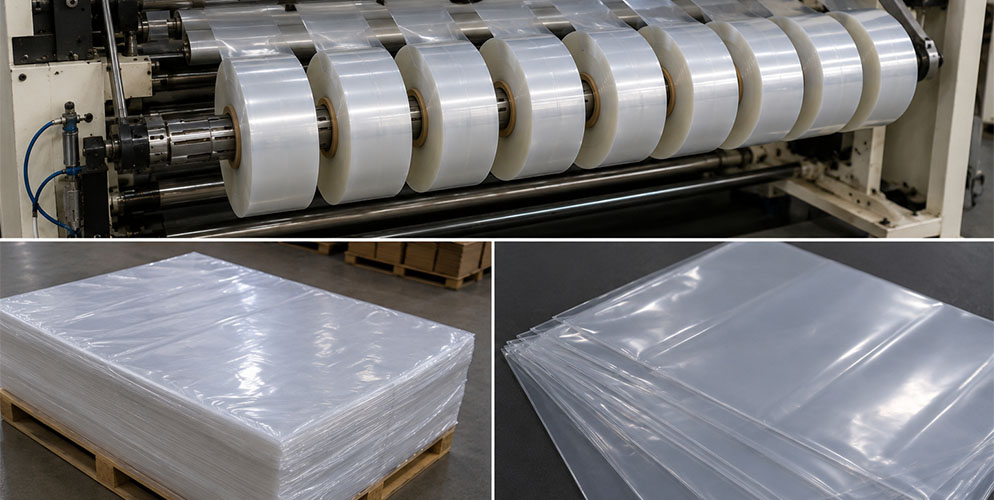
What Is Plastic Film Slitting?
Most plastic film starts in large rolls, often wider than what a customer needs for a specific machine or application. Slitting brings that roll down to a smaller width, so it can feed properly into the next step of production.
Think about a packaging line, a printer, a laminator, or a coating system. Those machines are built around specific material widths. If the roll is too wide, it may not fit. If it is not slit cleanly, it can create tracking issues, edge problems, or unnecessary waste.
So essentially, slitting helps avoid those headaches by taking larger rolls of film and cutting it into narrower rolls. In this process, the material will stay on the roll, but it is converted to a more usable size.
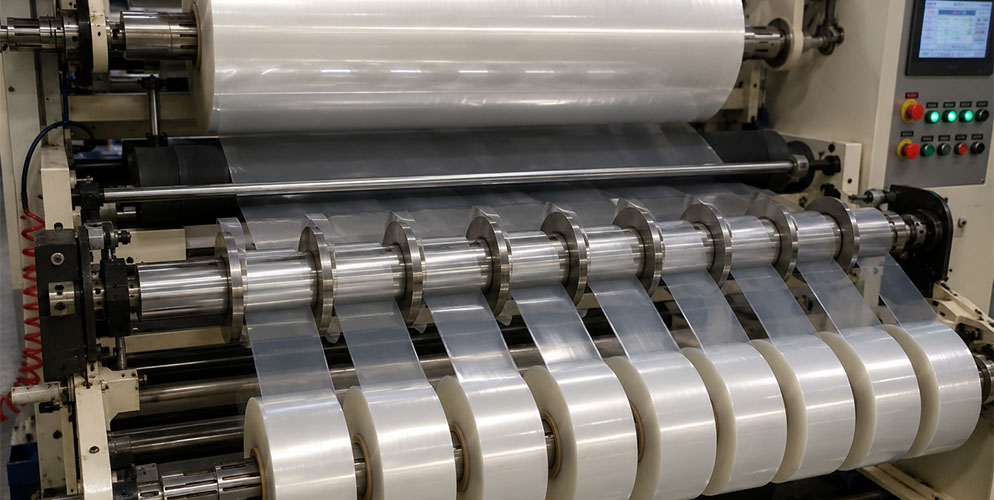
When Slitting Is Usually the Better Choice
Slitting makes the most sense when your process is built around rolls. If the equipment you use pulls film continuously from a roll, you probably want slit rolls. That format keeps production moving without requiring someone to stop, cut, stack, or manually feed individual pieces. Slitting is also useful when you want to reduce waste from oversized rolls.
Slitting is commonly used for:
- Packaging lines
- Printing equipment
- Coating systems
- Laminating processes
- Labeling applications
- Roll-fed manufacturing equipment
What Is Plastic Film Sheeting?
Plastic film sheeting takes film from a roll and cuts it into flat sheets. Instead of receiving one continuous roll, you receive individual pieces cut to a specific length and width. Those sheets can then be stacked, counted, packaged, printed, inspected, assembled, or used in another process.
A roll can be efficient when a machine is doing the work. But if people need to handle the material by hand, or if the film needs to be used as individual pieces, a roll may add extra steps. Someone has to cut it. Someone has to measure it. Someone has to keep each piece consistent. Sheeting handles that work before the material reaches your floor.
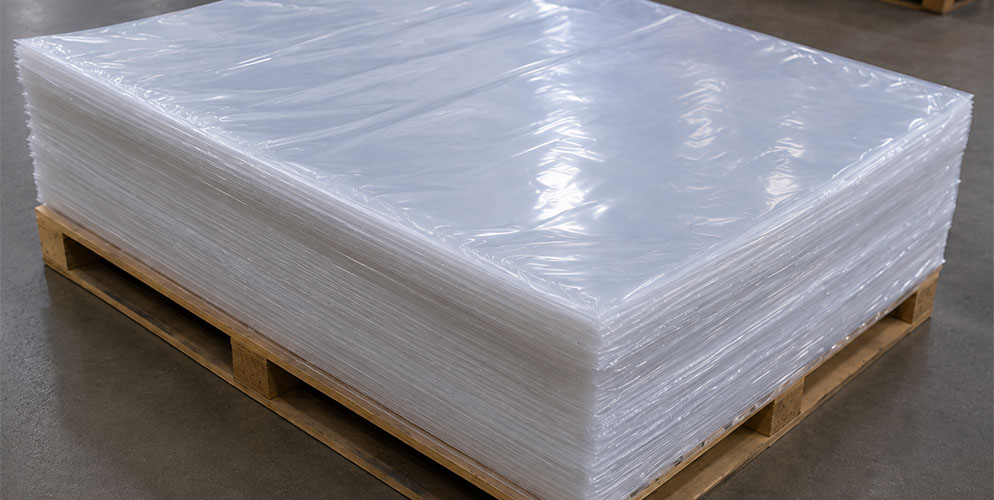
When Sheeting Is Usually the Better Choice
Sheeting is often the better option when the application calls for flat, pre-cut pieces.
That might include film used for printed graphics, protective layers, packaging inserts, displays, fabrication, electronics, assembly, or any process where sheets are easier to handle than rolls.
Sheeting can help when you need:
- Consistent sheet sizes
- Easier stacking and counting
- Material that can be printed or fabricated flat
- Pre-cut pieces for assembly
- Less manual cutting in-house
- Better control over handling and packaging
Sheeting is also beneficial in terms of labor. If your team is spending time cutting film down before they can use it, sheeting may save time and reduce inconsistency.
Start With Your Equipment
Your equipment will often answer the question for you. If the film feeds into a machine from a roll, slitting is probably the right path. Roll-fed equipment depends on the roll being the right width, wound properly, and cut cleanly enough to move through the system without creating problems.
If the film will be printed flat, stacked, trimmed, packaged, assembled, or handed from one workstation to another, sheeting may make more sense.
A few useful questions to help determine which option is best for you:
- Will the material run continuously through a machine?
- Does the machine require a specific roll width?
- Will someone need to handle individual pieces?
- Does the film need to be stacked or counted?
- Are we cutting material in-house right now because it arrives in the wrong format?
- Those answers usually point you in the right direction.
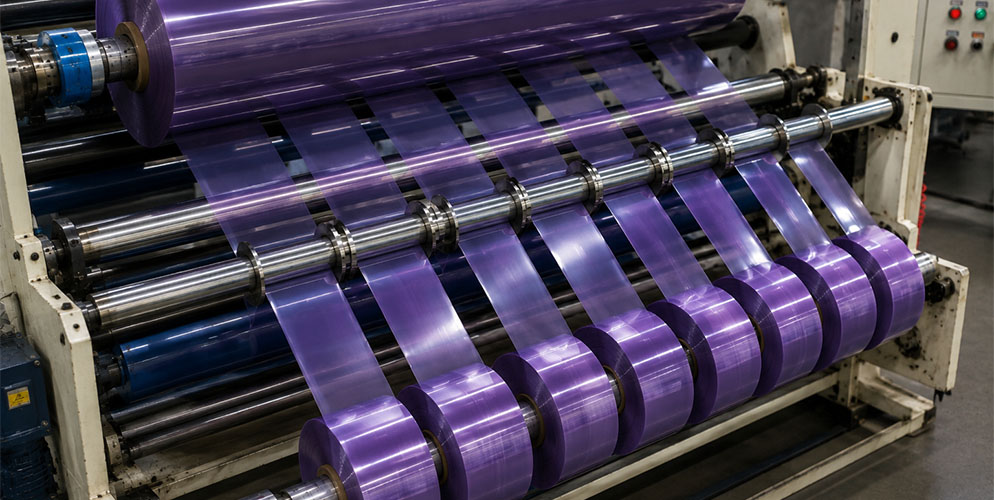
Do Not Forget About Plastic Film Handling
Rolls can be efficient, but they also need to be stored, moved, mounted, and unwound. Depending on the size and weight, that may require equipment or extra handling steps.
Sheets can be easier to distribute across workstations. They can be counted, stacked, inspected, or packed into kits. For manual or semi-manual processes, sheets may simply be easier to live with.
A material may be technically correct, but if the format slows down your team, creates extra cutting, or complicates storage, it is not really production-ready.
Which Format Reduces Waste, Slitting or Sheeting?
Both slitting and sheeting can reduce waste, but in different ways. Slitting helps reduce waste when a roll is too wide for the equipment or application. By cutting the roll to the correct width, you can avoid excess trim, poor alignment, and material that does not fit the process.
Sheeting helps reduce waste when teams need consistent flat pieces. Instead of cutting film manually and dealing with off-size pieces or scrap, the material arrives closer to its final usable form.
A lot of waste happens because the material is almost right.
Almost the right width.
Almost the right size.
Almost easy to handle.
Custom converting with PolymerShapes helps close that gap.

Can Plastic Film Be Slit and Sheeted?
Yes, and in some cases, that is exactly what makes sense. A larger roll might first be slit to a specific width, then sheeted into specific lengths. That kind of converting sequence can be useful when the final application requires flat sheets with consistent dimensions.
The right sequence depends on the material, thickness, tolerances, quantity, and end use. Some films are easier to convert than others. Some applications require tighter control. Some projects need special packaging or handling after the converting work is done.
This is where it helps to have a conversation with one of our conversion expats before placing an order. A good converting partner can help determine not only what size you need, but also the best way to get there.
What to Know Before Asking for a Quote or Sample from PolymerFilms
You do not need to have every technical detail figured out before reaching out. But a few pieces of information can make the quoting process much smoother.
Helpful details include:
- The type of plastic film (we can also help you select the right film for your application)
- Film thickness or gauge
- Desired roll width or sheet size
- Quantity needed
- Tolerance requirements
- How the film will be used
- Whether the material will run through equipment
- Packaging preferences
- Any downstream process, such as printing, laminating, assembly, or fabrication
The most useful detail is often the application. When the converter understands how the film needs to perform, they can help recommend the right format.
The Bottom Line for Slitting and Sheeting
Plastic film slitting and sheeting both prepare film for real-world use. They just solve different problems. Slitting turns large rolls into narrower rolls. Sheeting turns rolls into flat pieces.
One supports continuous production. The other supports easier handling, stacking, printing, packaging, or assembly.
PolymerFilms offers plastic film converting services, including slitting and sheeting, to help customers receive material in the format that best fits their application. Whether you need precision rolls, consistent sheets, or a custom converting workflow, the right format can help reduce waste, simplify handling, and keep production moving.
Recent Posts
Help us spread the word by sharing with the community!